



Retail Fraud Prevention: 2026 Guide to Stop Ecommerce Losses

Retail fraud prevention used to sound straightforward: Stop bad orders before they turn into losses. But for online retailers, the job has become fairly complicated.
Fraud is more varied, adaptive and expensive than it used to be. In fact, Juniper Research found that global ecommerce fraud losses hit just over $56 billion at the end of last year, and they’re expected to reach $131 billion by 2030.
That growth makes fraud prevention an obvious priority, but stopping retail fraud isn’t as simple as blocking more orders or tightening every rule. In this guide, we’ll go over the most common types of retail fraud, why false declines can be just as costly as fraud that gets through and what to look for in a fraud prevention solution built specifically for ecommerce retail.
TL;DR
- Retail fraud prevention is the practice of identifying and preventing fraudulent activity that targets online retail stores before it results in financial losses and tarnished trust.
- Payment fraud, account takeover fraud, post-purchase and returns abuse, promo abuse and friendly fraud are some of the main types of risks that retail fraud prevention targets.
- A fraudulent order costs more than the value of the transaction itself. Lost merchandise, shipping, payment fees, chargeback fees, manual review, customer service time and reverse logistics all add to the true cost of ecommerce fraud.
- Fraud controls that are too strict can create their own revenue problem. False declines block genuine orders, frustrate good customers and can hurt customer lifetime value (CLTV).
- Retail-specific fraud prevention uses ecommerce context, like SKU-level data, shopper behavior, seasonality and pre- and post-purchase signals, to identify risk more accurately than generic fraud rules.
The real cost of retail fraud
A $50 fraudulent order may just look like a $50 loss on paper, but the real cost runs deeper. LexisNexis found that U.S. merchants lose an average of $4.61 for every $1 of fraud. The initial lost merchandise, fulfillment/shipping costs, payment processing fees, chargeback fees, customer service time, manual review resources, reverse logistics costs (like those from a fake item being returned in place of the original product) and the operational work required to investigate and respond to claims all add to the total cost of ecommerce fraud.
So, that $50 order doesn’t cost you $50. Using a $4.61 true-cost fraud multiple based on LexisNexis’ findings, that one order adds up to $230.50 in actual business impact.
But retail fraud doesn’t always follow the same pattern, so it’s important to be able to understand the most popular types merchants tend to face.
What common types of fraud affect online retailers?
Online retailers face a distinct and evolving mix of fraud types.
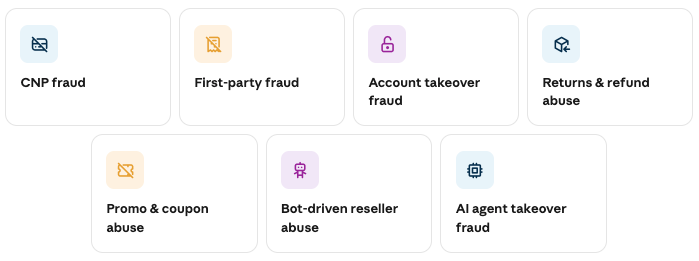
Card-not-present (CNP) fraud
A fraudster uses stolen card credentials to purchase goods online. Because there’s no physical card to verify, the transaction can look legitimate at checkout despite the credentials being compromised.
First-party fraud
Also called friendly fraud, a customer makes a legitimate purchase, receives the order then disputes the charge with their bank, usually claiming non-delivery or an unauthorized transaction. Because the customer and card are both real, traditional fraud signals typically don’t trigger.
Account takeover fraud
A fraudster uses stolen credentials to access a legitimate customer’s account and place orders using saved payment methods, stored addresses or loyalty point balances.
Returns and refund abuse
A customer or organized fraud ring exploits a merchant’s return policy — returning used, damaged, or switched-out products or claiming non-delivery for orders that were, in fact, received.
Promo and coupon abuse
Fraudsters create multiple accounts or use synthetic identities to redeem sign-up offers, referral bonuses or first-order discounts beyond their intended limit. Without a cross-merchant identity network, each account appears new and each redemption looks legitimate.
Bot-driven reseller abuse
Automated bots purchase limited-edition or high-demand inventory the moment it goes live, stripping stock from legitimate customers. The goods are then resold at a premium on secondary markets.
AI agent takeover fraud
An emerging threat in agentic commerce, fraudsters hijack a legitimate AI shopping agent — exploiting the credentials, permissions or trusted status that a consumer has granted it — to make unauthorized purchases.
Because each fraud type works differently, brands like yours need fraud controls that are precise enough to stop real abuse without treating every unusual order as a threat. When controls are too broad, you may reduce some fraud exposure while also creating new problems.
The price of too-strict fraud controls
Beyond fraud that makes it through, there’s the problem of fraud prevention that’s too blunt: legitimate orders declined because a generic rule flagged them as suspicious. These false positives cost merchants revenue and damage long-term customer relationships in ways that don’t show up cleanly in a fraud dashboard, but do show up in CLTV metrics. In fact, Signifyd found that 13% of shoppers won’t shop with a retailer again after one bad experience, i.e. being mistakenly turned away, and 82% won’t tolerate more than two poor experiences.
To put that into perspective, if a retailer with a $70 average order value (AOV) mistakenly declines just 100 legitimate orders in a year, that’s $7,000 in immediate lost revenue. If 13% of those customers never return and they were expected to make, say, seven purchases over their lifetime on average, that’s an additional $6,370 in unrecoverable revenue, bringing the total to $13,370. If that scenario plays out five times, that’s almost $70,000 in avoidable losses.
My personal experience of being falsely declined by a global fashion retailer
I had just moved to Singapore, started a new job and only had two weeks to find an outfit for a disco-themed office party. Rather than just go with a traditional ‘70s-themed outfit, I decided I needed to be the disco ball.
I tried shopping in-person at dozens of stores but couldn’t find exactly what I was looking for. So, I turned to some tried-and-true global fashion retailers that would ship and deliver to Singapore in time for the party. After browsing around various sites, I found the perfect dress that happened to be on sale with a retailer I had shopped with before in the U.S. I logged into my account, added the dress to my cart, browsed a little more and ended up with a cart worth about $300 SGD (or almost $233 USD) — oops!
I updated my shipping address to my new address but used the payment/billing details saved to my account as I hadn’t gotten a new credit card yet. I checked out and my order was instantly declined by the merchant. Then my account was immediately blocked with no option to verify my identity.
From a fraud system’s point of view, I can see why the order looked risky:
- Dormant account
- New international shipping address
- Mismatch between billing and shipping information
- Different currency
- A sudden large purchase attempt
But I was also a legitimate returning customer who:
- Had successfully logged into my account on the first try, albeit from a new location
- Confirmed my credit card’s CVV code
- Needed this exact dress ASAP
I contacted support and explained my situation. They couldn’t reactivate my account but were able to route my ticket through to their security team. I heard back from their security team within 24 hours and sent a few emails back and forth. They eventually let me back into my account and I successfully placed the order.

Now, if the situation had been different, I wouldn’t have gone through the trouble to talk to support, chat with security, provide whatever details they needed to confirm my identity, wait for them to reinstate my account, rebuild my cart and attempt the order again. I would’ve just given up, shopped with another brand instead and, realistically, never given them another chance.
In my case, the retailer almost lost a ~$233 order from a real returning customer with an AOV of $180. Sure, that may seem like a pinhole in the bottom of a bucket for a big global retailer. But what if a similar scenario played out for 50 other customers who weren’t as stubborn as I was? Or 100? Or 500? Then it’s not such a small leak anymore.
The key takeaway here isn’t that retailers should approve every order. It’s that your retail fraud prevention solution needs to be precise enough to separate actual fraud from legitimate customer behavior that simply falls outside the norm. Without that context, the same controls meant to protect revenue can end up blocking it.
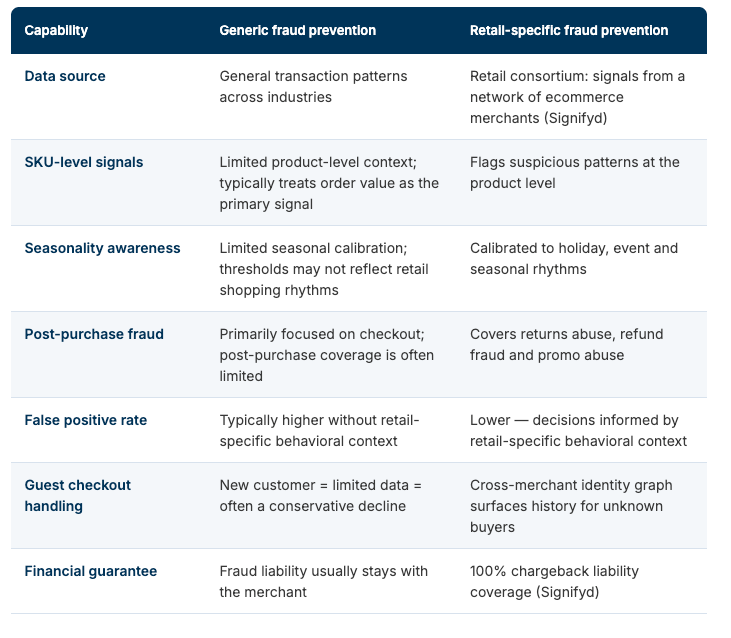
Retail-specific vs. generic fraud prevention: At a glance
Not all fraud prevention solutions are built the same. Here’s a quick comparison of a retail-specific fraud prevention solution vs. generic fraud prevention solution.
How retail-specific data improves fraud detection
Retail-specific fraud prevention works because the underlying data is different. Instead of generic transaction signals, it draws on a richer set of inputs — ones that reflect how real shoppers actually behave across products, seasons, channels and purchase contexts.
SKU-level data analysis
Effective fraud detection in retail requires deep SKU-level granularity and an understanding of diverse product categories. Fraud patterns often vary significantly between different types of products. For example, fraudsters often target specific high-value or easily re-sellable items such as exclusive launches. By analyzing patterns at the SKU level, a retail-specific model can identify suspicious ordering behavior that generic systems might miss.
Buyer patterns
Retailers encounter distinct buying behaviors influenced by seasonality, payment methods, demographics, etc. A generic solution applies the same risk rules to all customers based on general fraud indicators. For example, there has been an increased adoption of subscription payments in retail. When a retail-specific solution encounters subscription-type payments, it would ignore the absence of device ID and IP address while risk decisioning, whereas a general solution would deem such a transaction as risky and problematic. Understanding these patterns helps distinguish between a repeat customer and a potential fraudster.
Seasonality
Retail is cyclical. Holidays, back-to-school periods and other seasonal events significantly impact shopping behaviors. A retail-focused fraud prevention system accounts for these fluctuations and incorporates seasonal trends into its risk assessment. For example, during holiday seasons when it is normal to expect an increase in sales for gift-related items, a retail-focused fraud prevention solution would take this seasonality trend into account, while also detecting out-of-season fraud attempts that a generic system might miss.
Event-driven shopper behavior
Retail fraud detection relies on identifying subtle behavioral anomalies that vary with the shopping context, such as rapid cart additions or using unusual payment methods during sales events. For example, retail-specific solutions deploy sophisticated anomaly detection and feedback loops to continuously improve their fraud protection. This helps the system recognize new patterns that emerge over time, both for legitimate shopping behavior and fraud attempts. Solutions not tailored to retail might miss these cues or apply one-size-fits-all rules that fail to capture the complexity of retail transactions.
Pre- and post-purchase risks
Retail-focused fraud prevention goes far beyond checkout. Generic solutions tend to focus on the transaction moment. But retail fraud happens across the entire customer journey — at account creation, during checkout, at delivery and in the returns or chargeback process. By leveraging consortium models and retail-specific data, retail fraud prevention solutions, like Signifyd’s Commerce Protection Platform, can identify risks even in challenging scenarios like guest checkouts, where a customer may appear new to the merchant but not to the broader merchant network.
Does retail data give merchants a better defense against chargebacks?
Yes, stronger, retail-specific data can help you better defend against chargebacks. Here’s how (with real results):
Detecting missed fraud
Sophisticated fraudsters who understand retail patterns can slip through generic detection systems, leading to significant financial losses. For instance, they might exploit seasonal trends or target specific high-value SKUs in ways that generic systems aren’t equipped to detect.

A compelling case in this area is when Samsung worked with Signifyd to successfully tackle previously undetected fraud. Within the first six months, Signifyd identified and mitigated several fraud trends, including Korean IP fraud, Dominican Republic reshipper schemes, and loan fraud through Samsung’s financing partner, TD Bank. This partnership resulted in a 35% reduction in average monthly liability from these loans, saving Samsung $3.9 million in just six months. Moreover, this was accomplished while also boosting order approval rates.
Reducing false positives
While missing fraudulent orders is undoubtedly costly, rejecting valid ones can be even more detrimental in the long run. Generic fraud solutions, lacking a nuanced understanding of retail’s unique patterns, often struggle with this delicate balance. They’re prone to both over-declining legitimate orders and letting sophisticated fraud slip through, creating a lose-lose scenario for retailers.

To address this challenge, a leading ecommerce giant turned to Signifyd to eliminate shipping delays and manual reviews, boosting customer lifetime value by reducing false positives and enabling faster shipping. This partnership resulted in a 14% increase in approval rates and a 65% reduction in false positives, culminating in a $445 million annual topline impact while shifting liability for all fraud losses across their omnichannel experience.
Eliminating inefficient manual reviews
Without contextual data, your fraud team may spend unnecessary time reviewing legitimate transactions, reducing overall efficiency. A retail-specific system provides rich context (e.g., product details, customer history, seasonal factors), allowing quicker, more accurate manual reviews when needed.

A prime example of Signifyd’s impact is seen with Cuts Clothing, which fully outsourced their commerce protection to focus on growth. This shift allowed them to confidently expand into markets like Australia, Canada, the EU and Hong Kong. With an order approval rate over 99% and zero spend on chargebacks, Cuts Clothing saw a 122% ROI within six months. This freed up their team to focus on expanding their product line, a move that proved highly successful.
How to evaluate a retail fraud prevention provider
To stay ahead of fraudsters, it’s crucial for retail merchants to implement fraud prevention solutions that understand the nuances of retail ecommerce. Look for fraud prevention solutions that have:
- Deployed machine learning and AI models based on data from a global consortium of retailers.
- Invested in automated, rapid model refreshes. This ensures new training patterns are quickly integrated into a model’s context, thus enabling models to stay ahead of emerging retail trends.
- Reporting and analytics that are real time and properly represent the retail buyer journey.
- Leadership with retail expertise. Their industry knowledge enhances risk assessment beyond general strategies. Understanding retail operations, trends and customer behavior allows for more accurate fraud detection, fewer false positives and improved customer satisfaction in ecommerce.
- The ability to show authority in retail both through customer stories demonstrating results and collaboration.
- A financial guarantee for fraud protection— meaning the provider takes liability rather than passing it back to you if something slips through.
Protect more revenue and stop more fraud with retail-specific intelligence
Remember, in the world of retail fraud prevention, context is king. Generic solutions might catch obvious fraud, but broad rules and isolated transaction data are not enough to protect both your customers and your business. You need intelligence that understands how real shoppers behave across products, channels, seasons and the full buyer journey.
Signifyd’s Commerce Protection Platform brings that retail-specific context into every decision, helping merchants identify fraud and abuse before it turns into losses while reducing false declines that block legitimate customers. With machine learning models powered by data from our Commerce Network and a financial guarantee that shifts fraud liability away from merchants, Signifyd helps retailers approve more good orders and stop more fraud — all at once.
Photo by Getty Images
Want a closer look at how fraud is evolving across ecommerce?




Every decision clear. Every outcome guaranteed.
THE SIGNIFYD GUARANTEE
Every decision clear.
Every outcome guaranteed.
We back every decision with a financial guarantee, because 15 years of data and refinement means we're confident enough to stake money on it. When Signifyd approves an order, you can act on it. If we're wrong, we cover it.