



The ultimate merchant’s guide to preventing chargebacks

Few things cut into an ecommerce merchant’s profits like chargebacks, and that’s one of the reasons why effective chargeback prevention is so important. When done well, it’s one of the highest-ROI investments brands like yours can make because stopping a dispute costs far less than paying for one.
Read on for the main chargeback triggers, prevention strategies and the tools that stop disputes before they start.
TL;DR
- Chargeback prevention is the set of policies, tools and operational practices a merchant uses to stop payment disputes before they turn into chargebacks.
- According to a Mastercard study, 75% of consumers take disputes straight to the card issuer instead of the merchant.
- LexisNexis found that retail and ecommerce brands face over $5 in total costs for every $1 lost to fraud in 2026 — up from $4.41 for every $1 lost to fraud in 2024.
- You can prevent chargebacks by having clear return/refund policies, responsive customer service and easy refunds, optimized billing descriptors, purchase verification tools (like AVS and CVV) and automated fraud prevention.
Understanding chargebacks and their impact on your bottom line
A chargeback happens when a customer disputes a charge with their bank, which reverses the transaction. While the original purpose of the chargeback process was to protect consumers against criminal fraud, customers looking to get free merchandise or services have started to abuse the privilege through a process called first-party fraud or “friendly fraud.”
According to a Mastercard study, about 75% of consumers take disputes straight to the card issuer instead of contacting the merchant, leaving you no chance to resolve the issue before it becomes a chargeback. And the impact is more than just the dollar amount reversed. Each chargeback results in fees from payment processors and card networks like Visa and Mastercard. Administrative costs to respond to disputes along with potential merchandise and shipping costs for unrecoverable items inflate total losses. In fact, LexisNexis’s 2026 study puts the total at about $5.13 per $1 lost to fraud.
What happens when you have high chargeback rates in ecommerce?
When left unchecked, high chargeback rates can:
- Damage your reputation with banks and processors, resulting in higher fees and held or frozen funds
- Lead to account termination, cutting off your ability to accept card payments
- Trigger card network monitoring programs like Visa’s VAMP, which can add per-dispute fees and increased scrutiny once you cross a certain ratio threshold (1.5% in 2026)
- Land you on Mastercard’s MATCH list (formerly called the “Terminated Merchant File”), which can make it very difficult to get a new merchant account for up to five years
To prevent any of the scenarios above and reduce chargebacks, it’s important to understand the main triggers behind them first.
What are the main chargeback triggers?
There are several reasons why different types of chargebacks, including fraud and nonfraud, occur. Here’s a look at the common ones.
Fraudulent transactions
Chargeback fraud comes in several forms. Some fraudulent chargebacks result from outright criminal fraud using stolen credit cards. But friendly fraud chargebacks — customers requesting a chargeback, deliberately claiming they didn’t make a purchase to get goods or services for free — is also common.
| How to handle a fraudulent transaction chargeback scenario |
| First, identify which type it is: Criminal fraud or first-party/friendly fraud. Confirmed criminal fraud: Win rates for genuine fraud disputes are low and it’s often not worth the cost of fighting. Learn from the experience and leverage fraud detection and fraud prevention tools to stop the next one. First-party/friendly fraud: Contest it. Submit delivery confirmation, device/IP data and order history through representment. File before the card network’s response deadline, since a late response means an automatic loss. |
Product or service issues
When customers claim they never received the product ordered, it arrived damaged or defective, or it was not as described on the website, they may file a chargeback.
| How to handle a product or service issue chargeback scenario |
| For non-delivery claims, provide tracking numbers and delivery confirmation. For wrong or defective item claims, gather and submit evidence of what was shipped. |
Descriptor issues or processing errors
If the merchant’s name on the credit card statement is unrecognizable or unclear, customers may not recognize the charge and dispute it.
Processing mistakes can also trigger disputes directly, including duplicate charges, incorrect authorization or product codes and delayed settlement.
| How to handle a descriptor issue or processing error chargeback scenario |
| For unrecognized-charge disputes, submit evidence tying the transaction to the customer (I.e. order details, billing descriptor, purchase confirmation). For genuine processing errors like a duplicate charge or incorrect amount, issue a refund promptly rather than fighting the dispute, since this was an error on your end. |
Subscription issues
Customers sometimes dispute recurring subscription charges after an initial free trial if they didn’t intend to purchase or thought they properly canceled. They may also file a dispute explaining that they wanted to cancel a subscription but were unable to.
| How to handle a subscription issue chargeback scenario |
| If a renewal is disputed, respond with evidence the customer agreed to recurring billing: The signup record and accepted terms, proof the service was active or used that period, your cancellation policy and evidence showing no cancellation was received by the required deadline, per your policy. |
Chargeback prevention strategies
While chargebacks may never fully be eliminated, there are proactive steps you can take to prevent and mitigate most invalid disputes.
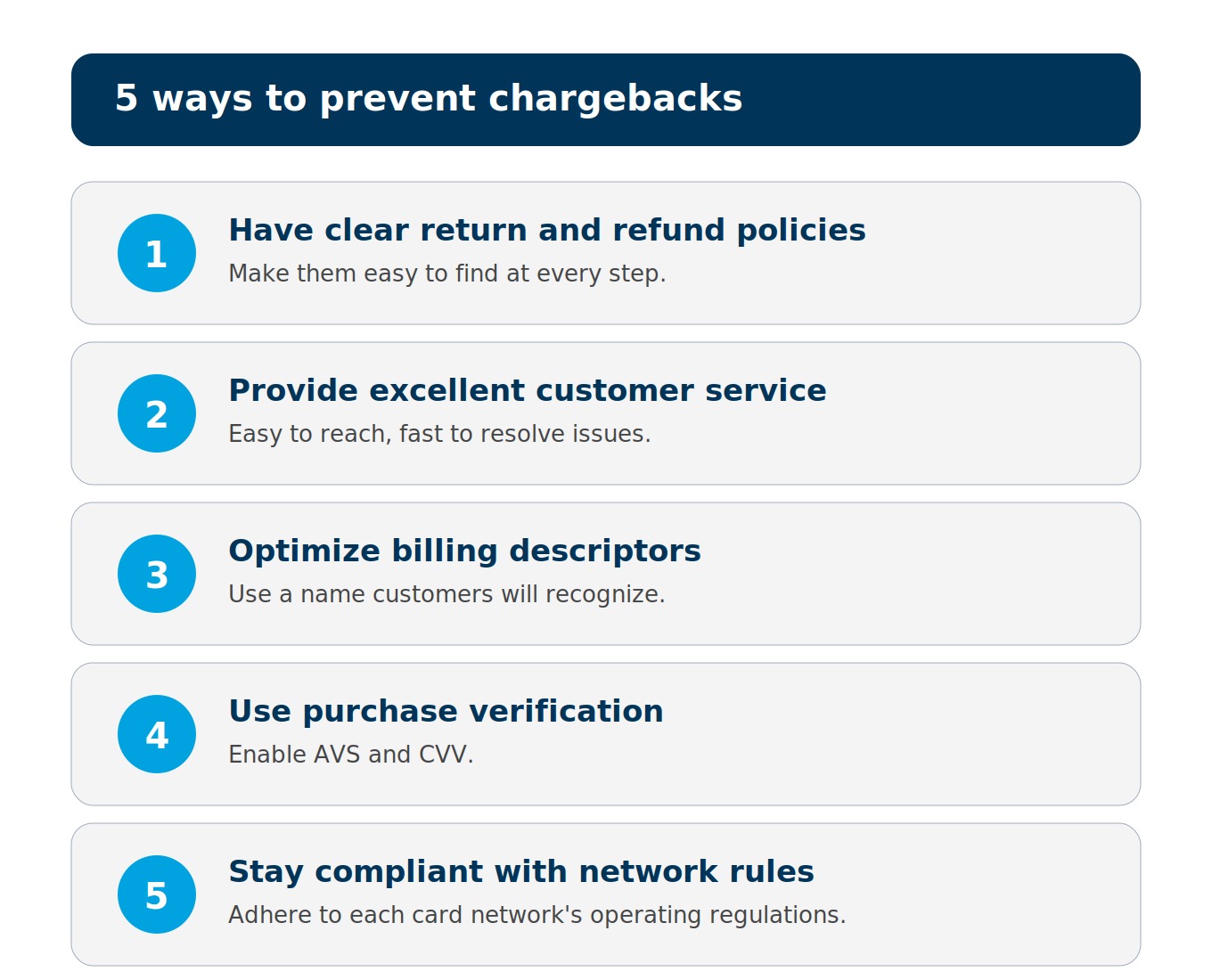
1. Have clear return/refund policies and make them visible
Customers are more likely to go through proper refund channels instead of disputing a charge if return policies are clear and easy to find across your website, receipts and confirmation emails.
2. Provide excellent customer service
Make yourself easy to reach across the channels people actually use (chat, email, phone, social media), respond fast and give frontline staff the authority to resolve issues on the spot. A customer who gets a quick “yes” from you often never calls their bank.
3. Optimize billing descriptors
Put a recognizable business name or storefront URL in your billing descriptor. Then, check how it renders across the major card issuers — formatting varies and a descriptor that’s clear on one statement can be truncated to nonsense on another.
4. Use purchase verification
Turn on address verification (AVS) and CVV matching at minimum, and add issuer-backed authentication like 3-D Secure for higher-risk orders. While 3-D Secure (3DS) can shift fraud liability to the issuer, it also adds friction to the transaction, so be deliberate about using it.
5. Stay compliant with payment network rules
Technical violations trigger chargebacks too: Incorrect product codes, duplicate charges or late settlement can each cause one. Know the current operating regulations for each card network you accept and build your processes around them so you can avoid the fees and penalties that come with crossing a network’s monitoring thresholds.
Are there tools or services to help with preventing or disputing chargebacks?
Yes, there are, and different categories serve distinct purposes.
| Tool category | What it does |
| Chargeback fraud prevention | Screens orders at checkout with combined machine-learning and human review, catching risky orders automatically while keeping false declines low |
| Chargeback alerts | Provides advance warning of disputes, giving merchants time to issue refunds and prevent chargebacks before they happen |
| Network inquiry tools | Connects merchants to card networks to share transaction evidence and resolve disputes pre-chargeback |
| Representment services | Helps fight chargebacks after they’re filed, resubmitting the case with evidence to recover funds. |
| Chargeback monitoring/management | Tracks your chargeback and fraud ratios so you can act before crossing a card network’s chargeback threshold. |
Chargeback fraud prevention
Prevention begins with order approvals. A brand who approves every order is bound to get chargebacks. One who blocks every order with any level of risk will end up with “false positives” by accidentally rejecting good orders. While you can conduct manual review to help prevent bad orders, this creates a delay for the customer and high costs for your business.
The solution is fraud prevention built directly into your order process, so risky orders are caught automatically without slowing down good customers. Modern tools combine automated machine-learning review with human review to catch fraud while keeping false positives low. And when a provider (like Signifyd, for example) also guarantees fraud protection, provides complete protection against chargebacks and takes on liability for any that may slip through, the financial risk of chargebacks shifts off your books entirely.
Chargeback alerts
Chargeback alert services provide advance warning of potential disputes from participating banks. They give merchants a short window (typically 24–72 hours) to resolve issues and avoid a formal chargeback.
Network inquiry tools
Network inquiry tools — like Visa’s Order Insight — share detailed transaction information with the cardholder’s bank at the moment they question a charge, so legitimate purchases get recognized before they escalate into a dispute or turn into a chargeback.
Advanced chargeback representment services
Companies like Signifyd help merchants recover losses from chargebacks by resubmitting cases with compelling evidence to get illegitimate chargebacks reversed and funds returned. They handle the entire representment process, meeting deadlines and completing every recovery step for the merchant. Some (with Signifyd being one of them) guarantee that chargebacks from approved orders are covered and reimbursed.
Chargeback monitoring/management
Constant monitoring keeps your chargeback and fraud ratios in view so you can act before they cross a network threshold, not after the fees hit. This matters more under Visa’s VAMP program — the VAMP ratio counts fraud reports (TC40s) that may never turn into actual chargebacks, brands who only watch their chargeback numbers can badly misjudge where they really stand. Vendors like Signifyd give you that full visibility, and some acquiring banks offer similar tracking, though by the time your acquirer flags you, you’re often already close to the line.
Ongoing chargeback management strategies
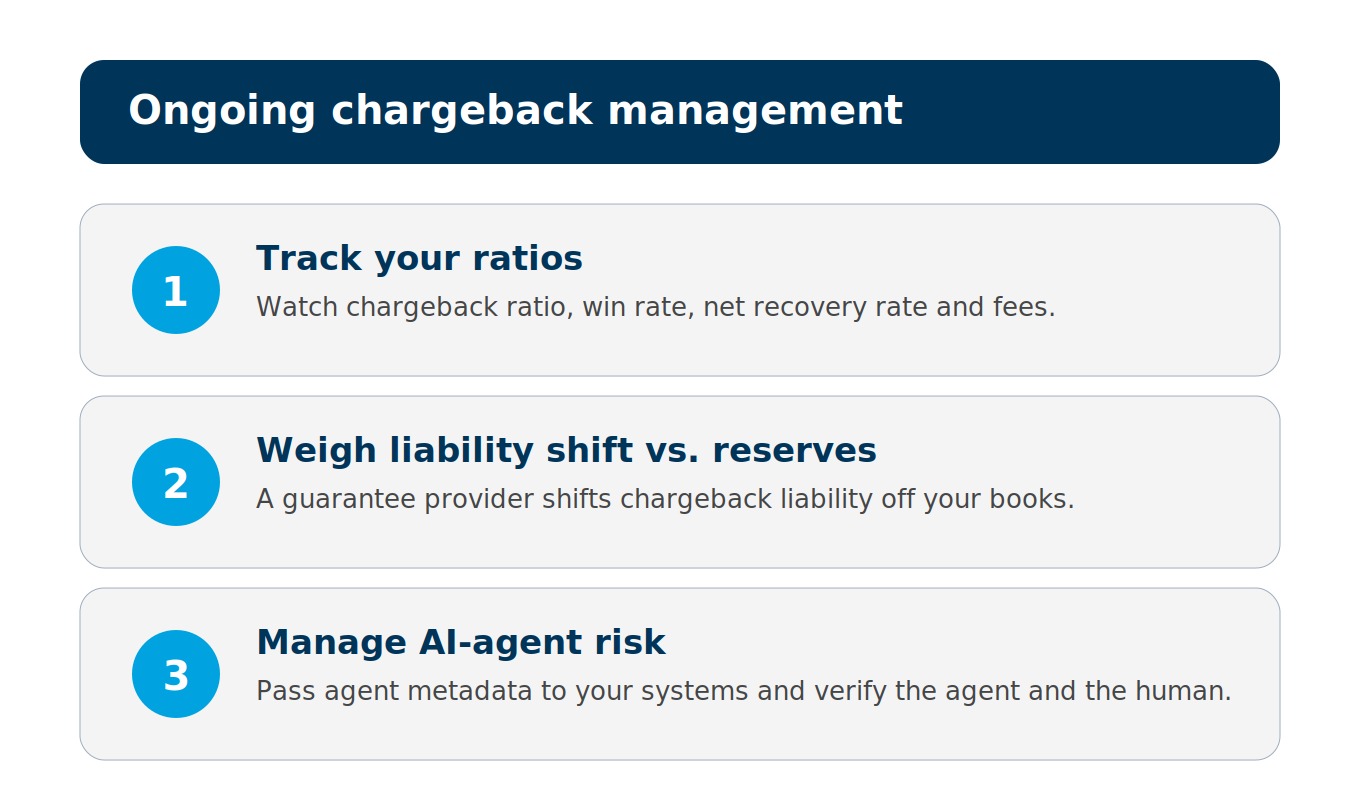
Track your chargeback and fraud ratios
Monitor the metrics that show whether your strategy is working: Your chargeback ratio, win rate (the share of disputes you fight and win), net recovery rate (the share of all filed chargebacks you actually recover) and total fees paid over time.
As a benchmark, aim to keep your combined dispute ratio comfortably below VAMP’s “excessive” threshold. The best risk teams tend to set an internal ceiling well under the network limit to leave headroom for a sudden fraud spike.
Weigh liability shift vs. reserves
For some larger merchants, a reserve to cover potential disputes can make financial sense. Merchants of any size might do better to work with a reputable fraud protection vendor providing liability shift, an innovative approach where the vendor guarantees that chargebacks from approved orders are covered, shifting liability from the merchant to the vendor.
Manage chargeback risk from AI agents
Chargeback management is a moving target, and the fastest-moving piece right now is agentic commerce, where AI agents shop and check out on behalf of human customers. In LexisNexis’s 2026 study, more than two-thirds of U.S. merchants reported concern about fraud tied to these transactions, because an agent’s behavior (rapid, sequential, cross-category orders) can look like a compromised account to a traditional rules-based system. That means both false declines on legitimate agent orders and missed fraud that later becomes a chargeback.
There are a few things you can do now to help prevent agent-related chargebacks:
- Pass agent metadata (which agent, what permissions, what session) through to your fraud and order systems so they aren’t deciding blind
- Verify both that the agent is authorized and that the human behind it is legitimate
Since emerging standards like Visa’s Trusted Agent Protocol aren’t yet universal, lean on fraud tools that score behavior rather than static rules to tell an authorized agent from an adversarial bot.
Start building an effective chargeback prevention strategy
Chargebacks are a real drain on revenue and operations, but they aren’t a fixed cost of doing business.
The merchants who keep them low tend to layer the basics: Clear policies and billing descriptors, responsive service, fraud screening at checkout and prevention tools, backed by disciplined monitoring and a plan for disputing the chargebacks worth fighting. And what really separates them from merchants who struggle is treating prevention as an ongoing practice, not a one-time fix. After all, card-network rules keep tightening and fraud keeps evolving.
Keeping pace with all of it by hand is where most teams fall behind. And it’s the work Signifyd’s Complete Chargeback Protection within the Commerce Protection Platform is built to take off your plate: It screens orders at checkout, automates your dispute response and backs approved orders with a financial guarantee against both fraud and non-fraud chargebacks, so an entire category of risk leaves your books.
Photo by Getty Images
Want to learn more about how you can get total freedom from chargebacks with Signifyd?
FAQs
Is there a way to prevent chargebacks?
Yes. You can’t eliminate chargebacks entirely, but most invalid ones are preventable. The key steps: Screen orders for fraud at checkout, use clear billing descriptors, offer responsive service and easy refunds, keep return and subscription terms transparent and resolve disputes early with alert tools before they become chargebacks.
What’s the difference between chargeback prevention and recovery?
Prevention stops disputes before they’re filed, while recovery (also called representment) contests disputes after the fact to reclaim funds.
What’s the difference between Signifyd’s Complete Chargeback Protection and Chargeback Recovery?
They solve the problem at two different points. Signifyd’s Complete Chargeback Protection stops chargebacks from costing you in the first place, while Signifyd’s Chargeback Recovery helps reclaim revenue once a dispute is already underway.




Every decision clear. Every outcome guaranteed.
THE SIGNIFYD GUARANTEE
Every decision clear.
Every outcome guaranteed.
We back every decision with a financial guarantee, because 15 years of data and refinement means we're confident enough to stake money on it. When Signifyd approves an order, you can act on it. If we're wrong, we cover it.