





Get Commerce Protection Buyer’s Guide
What is a chargeback?
A chargeback is a forced transaction reversal initiated by a cardholder’s issuing bank, allowing the consumer to recover funds for a disputed credit or debit card purchase.
In the U.S., a cardholder has the right to request a refund from their issuing bank for any transaction or purchase made with their credit card.
Specifically, under Regulation Z within The Truth in Lending Act, which covers credit cards, and Regulation E in The Electronic Fund Transfer Act, which covers debit cards, cardholders are afforded reversal rights, meaning that they are guaranteed a right to receive their money back on a purchase and reverse the charge.
Usually, the cardholder recovers their money from the merchant directly, in the form of a return or refund. (Note that while a merchant may enforce “no refunds” in their return policy, ultimately, if a consumer receives a product that is broken, different than described or generally displeased with the purchase these regulations mandate that a merchant must honor the consumer’s right to a refund.)
In the case that the cardholder is unable to receive a refund from the merchant, or the merchant refuses to do so, a cardholder has the ability to contact the bank that issued them their credit or debit card (called the issuing bank) and file a chargeback request to recover the debt.
Types of chargebacks
The first thing to know about chargebacks is that they’re not all the same. When the cardholder initiates a chargeback, they’re prompted to give a reason for doing so. The most common reasons are:
- Billing dispute: Merchants who make billing errors (either by billing too much or double billing their customers) will be at risk of a chargeback. While many merchants proactively correct any billing errors, billing issues unbeknownst to merchants that don’t result in a quick refund will likely result in a chargeback.
- Broken item: When a customer receives an item that they claimed was broken upon arrival or quickly breaks down after, the merchant may receive a broken item chargeback.
- Item not received: Item not received (INR) is the chargeback filed against a merchant when a customer reports that they never received the goods that they paid for.
- Item significantly not as described: If a merchant ships a red t-shirt when a customer ordered a blue one, the merchant may receive an item significantly not as described (SNAD) chargeback.
- Transaction not recognized: This fraud-related chargeback is reported to merchants from customers who claim to not know why the transaction was reported on their card.
- Fraud, card not present: Card not present (CNP) fraud is a commonly reported type of chargeback fraud. It’s levied against merchants when a consumer claims that their card information was stolen and used without authorization
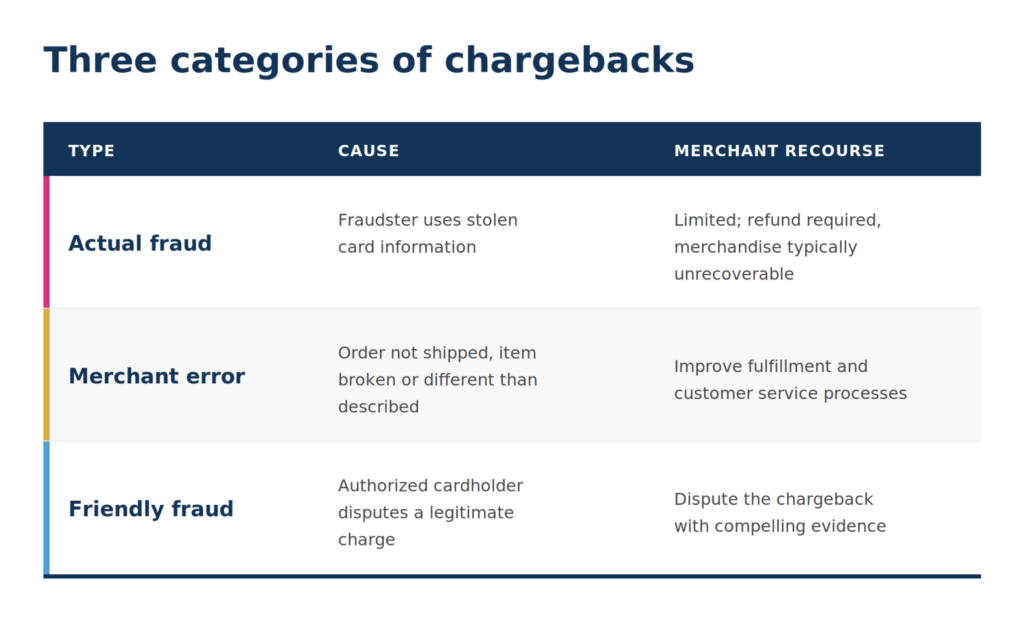
Most of these chargebacks are fairly self-explanatory, but they generally fall into three categories.
Actual fraud
The most obvious reason for a chargeback is also the most common. A fraudster used a legitimate cardholder’s information, purchased an item from a merchant and the merchant shipped said order to the fraudster. The real cardholder, seeing this charge on their statement, files a chargeback request with their issuing bank against the charges on their credit or debit card. In cases of actual fraud, there is little that merchants can do other than refund the sale amount without the expectation of receiving their items back.
Merchant error or negligence
The merchant either never shipped out the order or shipped out an item that was broken or different than described, and failed to provide good customer service to rectify the situation. When the authorized cardholder fails to receive the item they paid for, they file a chargeback on that transaction, requesting a refund.
Friendly fraud
Also called first party fraud, friendly fraud is an industry term for authorized cardholders who dispute seemingly legitimate charges to their credit cards. The authorized cardholder may file a friendly fraud chargeback on a legitimate charge for a few reasons:
- Intentional abuse (or “liar-buyer”): They want to avoid paying for the order in question
- Accidental chargeback: They may have forgotten they made the purchase
- Household confusion: There may be another household member who made the purchase in their name, and they don’t recognize the transaction
Ramifications of chargebacks for merchants
Because of the cost and time involved in the chargeback dispute process, card associations are extremely strict with merchants around what is acceptable for a chargeback rate. Most merchants are only able to reach a 1% chargeback rate on any form of payment (Visa, American Express, Mastercard, etc.) before being placed on a chargeback watchlist by that card association.
If a merchant incurs a chargeback rate greater than 1% of orders on a particular card association brand, (e.g. more than 1% of orders processed with Mastercard were chargebacks) that merchant has several detrimental penalties that they can incur.
The first and most painful are higher processing fees on all orders. For example, if a merchant’s normal processing fee for Visa was 3%, Visa could increase that fee to 3.5% or 4% to process all orders, cutting into the merchant’s profit margin.
Secondly, a merchant might lose the ability to fight chargebacks. If a merchant has suffered a high degree of chargebacks on American Express, AmEx might suspend that merchants ability to fight any chargebacks until the merchant brings down their chargeback rate.
Third, a merchant may be placed in a chargeback monitoring program, implemented by the card association to identify merchants with higher than normal chargeback rates. Merchants who land in a chargeback monitoring program may have restrictions placed on their merchant account and further fees levied as the card association attempts to help them reduce their chargeback rate.
Lastly and most seriously, if merchants fail to bring down their chargeback rate after several months, they might lose the ability to transact payments within a certain card association or even more seriously, might have their merchant account shut down by the acquiring bank, afraid of the losses they might incur by continuing to underwrite the merchant.
Frequently asked questions
What are the three types of chargebacks?
Chargebacks generally fall into three categories based on their root cause:
- Criminal fraud chargebacks: Also known as criminal fraud chargebacks, the cardholder’s payment information was stolen or used without their knowledge or consent, and they’re disputing a transaction they truly never made.
- Merchant error chargebacks: The dispute stems from a mistake on the business’s end, like billing the wrong amount, charging twice or failing to deliver a product or service as promised.
- Friendly fraud chargebacks: The cardholder made the purchase themselves but disputes it anyway, whether due to buyer’s remorse, forgetting the transaction, a family member using their card or an intentional attempt to get a refund while keeping the item.
What are some examples of chargebacks?
Common real-world scenarios that lead to chargebacks include:
- Criminal fraud chargeback example: A cardholder’s card details are stolen (via phishing, a data breach or card skimming) and used to make unauthorized purchases without the cardholder’s knowledge.
- Merchant error chargeback example: A customer is charged twice for the same order due to a processing glitch.
- Friendly fraud chargeback example: A family member makes a purchase using a shared card, and the primary cardholder doesn’t recognize the transaction later, assuming it’s unauthorized.
What is the chargeback rate threshold for credit card networks?
Most card networks set the chargeback rate threshold between 1% to 2%, but it varies according to the specific card network. Merchants exceeding the pre-defined rate risk penalties and monitoring programs, like Visa Acquirer Monitoring Program (VAMP) or Mastercard’s Excessive Chargeback Merchant (ECM) program.
How long do merchants have to respond to chargebacks?
Merchants typically have 20 to 45 days to respond once a chargeback has been filed, depending on the card network. Visa and Mastercard, for example, generally allow up to 30 days for merchants to submit evidence for their chargeback dispute case. However, the exact deadline imposed can also vary according to the merchant’s acquiring bank’s or payment processor’s policies. With that, it’s important to review the card network, payment processor and acquiring bank’s policies to ensure the deadline to respond to, and submit evidence against, the chargeback is met.
If you are an online merchant evaluating commerce protection vendors, you might be interested in our free Commerce Protection Buyer’s Guide. This comprehensive guide outlines the evolution of commerce protection from fraud prevention and details the integral components of a commerce protection solution. Takeaway resources include:
- A sample RFI template to leverage in your evaluation process
- Tips on how to build a business case for a commerce protection solution
- How to evaluate ROI and understand the tools used to protect against fraud and chargebacks
- How to find the right solution for your business
Need help fighting chargebacks? Learn how to cut costly chargebacks and recover revenue here.