



What is Payment Approval Percentage & How to Improve Your Rate

Payment approval percentage doesn’t always get the same attention as traffic or checkout conversion, but it has just as much impact on revenue. It’s simply a measure of how often good customer orders actually go through. When it’s strong, more of the orders you’ve already earned at checkout turn into settled payments. When it isn’t, legitimate customers get blocked somewhere between “place order” and “payment complete.”
In this blog, we’ll cover what a payment approval percentage means, how to calculate it, what “good” looks like in ecommerce and practical ways to improve it without increasing fraud or adding friction at checkout
TL;DR
|
What is the payment approval percentage?
The payment approval percentage is the amount of orders that actually go through after passing the issuer authorization and merchant approval processes.
A transaction must clear two checkpoints to be approved:
- Issuing bank authorization: The issuing bank must return an authorization code indicating the transaction can move forward to the merchant for review and approval.
- Merchant approval: Your fraud controls and review processes must also confirm the order is safe to fulfill.
If a transaction fails either step, it’s not counted in your payment approval percentage.
Payment approval percentage vs. authorization rate vs. capture rate
These measure distinct parts of the process:
- Payment approval percentage: Your final approval success rate, which includes issuer authorization plus merchant-side approval.
- Bank authorization rate: The percentage of orders approved by the issuing bank. This happens in addition to your fraud review process.
- Capture rate: The percentage of authorized, approved payments that are successfully captured and settled.
Since it reflects both issuer decisions and your own fraud approval process, your payment approval percentage gives you a fuller picture than authorization rate alone. Capture rate takes it one step further by showing how many approved orders actually settle as revenue.
How to calculate your payment approval percentage
Now that you know what the payment approval percentage represents and how it differs from authorization rate and capture rate, the next step is understanding how to measure it.
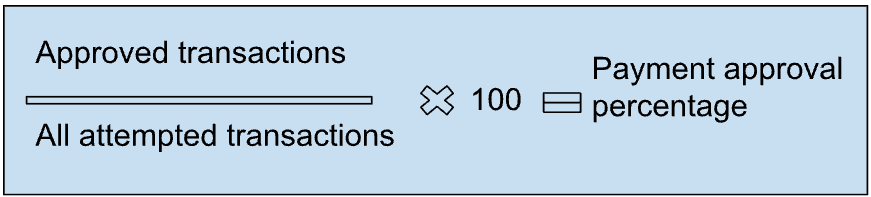
The calculation is simple: Approved transactions / All attempted transactions x 100 = Your payment approval percentage
For example, let’s say all of your customers combined attempt 10,000 transactions in a month.
- The issuing bank authorizes 8,900 of them
- You approve 8,700 of those authorized orders
Your approved transactions total 8,700. So, your payment approval formula is 8,700 ÷ 10,000 × 100 = 87. This means 87% of all attempted orders successfully cleared both issuing bank authorization and your internal review and approval process.
What is considered a good payment approval percentage in ecommerce?
Because payment approval percentage depends on your products, geographies and risk profile, there isn’t a single universal benchmark. That said, most payment and gateway providers treat 80% as the low end of “acceptable” for card-not-present (CNP) transactions and place healthy ecommerce businesses in the 85–95% range, with many recommending that online retailers aim for 90% or higher wherever possible.
Why your payment approval percentage may be lower than you’d like
If you calculate your payment approval percentage and it’s lower than you’d expect, it’s usually a sign that something in your payment flow is getting in the way of good orders. Declines can come from a lot of different factors, but most of the time they trace back to a few recurring patterns.
Issuer risk controls and false declines
Banks are conservative in how they evaluate card-not-present transactions, especially for cross-border orders or categories that tend to see higher fraud rates. When something even slightly out of the ordinary appears, like a transaction taking place from a new location or a higher-than-usual order value, issuers often default to caution and block the order. The problem is that caution doesn’t always distinguish between a suspicious transaction and a perfectly legitimate customer trying to check out. In fact, banks falsely decline about 15% of good online orders, according to Signifyd data.
Missing or inconsistent data
Another common culprit is the quality of the data the issuer sees. When billing and shipping details don’t line up, device signals look weak or expected data is missing, the bank’s view of the transaction becomes incomplete. A thin or inconsistent data trail makes issuers more cautious, and that caution directly lowers your approval percentage. Even if everything checks out on your end, the bank may still decline the order because the signals they rely on weren’t strong enough.
Processor routing and retries
Not all declines are about risk. Sometimes they’re simply the result of how the transaction was routed. A rigid or outdated routing setup can send orders through suboptimal paths, causing higher decline rates or unnecessary gateway errors. In other cases, the processor may retry an order through a path that historically performs poorly for certain banks or regions. These technical misfires often look like fraud declines to the customer, even when no risk was involved at all.
How a small lift in approvals can impact your revenue
Even a small lift in payment approvals can translate into a revenue boost. A 1% increase doesn’t sound like much by itself, but it represents a significant number of customers who are finally able to complete their purchase.
For example, if your customers attempt 100,000 transactions in a month with an average order value of $60, a 1% lift would mean 1,000 additional approved orders. That’s $60,000 in recovered revenue for that month, or $720,000 over the course of a year, without increasing traffic, launching new promotions or spending more on acquisition.
And the impact doesn’t end with the first order. Many of those recovered transactions come from loyal or returning customers, which means the long-term revenue lift is even stronger. A small improvement in approval performance today often leads to healthier retention and higher customer lifetime value (CLTV) over time.
How to improve your payment approval percentage
Filter risky transactions before authorization
One of the best ways to improve approvals is to make sure only high-quality traffic reaches the issuer in the first place. With pre-authorization screening through Signifyd’s Authorization Rate Optimization (ARO) solution, you can strip out obvious fraud and high-risk noise before it ever reaches the issuer. Over time, that cleaner stream of traffic lowers the perceived risk of your brand, which means fewer false declines and more good customers getting approved on the first try.
Optimize routing logic
Even when your fraud controls and customer experience are in a good place, you can still leave approvals on the table if transactions are routed through the wrong path.
By using dynamic routing instead of static routing logic, you can send each transaction to the acquirer, processor or payment rail with the best chance of success for that specific card type, BIN range, currency or geography. Rather than relying on a single default path, you route based on up-to-date performance data and issuer behavior.
Reduce manual review and speed up your internal approvals
Manual fraud review has its place, but if too many orders land in a queue, your effective approval percentage will suffer. When decisions lag or inconsistencies appear between analysts, legitimate transactions may be held unnecessarily or even declined.
The goal is to reserve manual review for the genuinely ambiguous cases. When you use machine learning (ML) trained on patterns from a broad network of merchants to automatically approve low-risk orders, your team spends less time reviewing transactions that were never risky to begin with and more time focusing on true edge cases. Solutions like Signifyd’s Guaranteed Fraud Protection, powered by a global consortium of ecommerce data, help cut manual review to a small fraction of overall volume. That shortens decision times, keeps more orders within authorization windows and strengthens both your approval percentage and your ecommerce customer experience.
Improve cross-border signals
Cross-border transactions often see lower approval rates because issuers can’t easily verify whether the behavior is normal for the cardholder. Small inconsistencies, like an unusual location, a different currency or an unfamiliar address format, increase the likelihood of cautionary declines.
You can improve cross-border approvals by making those orders easier to recognize as real. That can include working with local acquirers, supporting local payment methods, using step-ups strategically and relying on stronger device, identity and behavioral signals.
Strengthen the signals you send to issuers
A bank’s authorization decision is only as strong as the data they have in front of them, and historically, that data is quite weak. In most cases, issuers are looking at a thin slice of information — things like amount, merchant ID and timestamp — without any real context about who the shopper is, how they normally behave or what you’ve already seen on your side. With that narrow view, it’s safer to say “no,” even when the order is genuine.
You can shift those outcomes by sending richer, well-structured decision signals with every authorization request. That includes the result of your fraud review accounting for things like account tenure, order history, device details and prior chargeback behavior. Signifyd’s ARO solution can package and pass those signals downstream, giving issuers a clearer view of your traffic and creating a tighter feedback loop between merchants and banks. With that added context, issuers can approve more good orders, often boosting authorization rates by up to 3%.
Ready to stop leaving good orders on the table?
Every percentage point in your payment approval rate represents real customers, real revenue and real relationships you’ve already worked hard to earn. The good news is, you don’t have to accept unnecessary declines as a cost of doing business.
From pre-authorization screening and smart routing to automated, ML-driven fraud decisions backed by a financial guarantee, Signifyd helps you get more legitimate orders through — quickly and efficiently without adding friction for your customers.
Ready to see for yourself how to boost your payment approval rate? Book a personalized demo today.
FAQs
What can cause a low payment approval rate?
Common drivers include strict issuer risk rules, weak or inconsistent signals sent with the authorization request, suboptimal processor routing and too many orders stuck in manual review.
How can I improve my payment approval percentage without increasing fraud risk?
You can tighten approvals safely by screening out obvious fraud before authorization with a solution like Signifyd’s Authorization Rate Optimization, using dynamic routing to send transactions through higher-performing paths, reducing unnecessary manual review and sharing richer decisioning information with issuers.
What is a good payment approval percentage for ecommerce?
Healthy ecommerce businesses often aim for an approval percentage in the 85–95% range, targeting 90% or higher where possible.




Every decision clear. Every outcome guaranteed.
THE SIGNIFYD GUARANTEE
Every decision clear.
Every outcome guaranteed.
We back every decision with a financial guarantee, because 15 years of data and refinement means we're confident enough to stake money on it. When Signifyd approves an order, you can act on it. If we're wrong, we cover it.