






The ecommerce trends of 2026 signal a shift from chasing growth to competing on efficiency and trust, not to mention the ability to sell to both human shoppers and AI agents acting on their behalf.
But before we go into that, let’s look back at 2025: same-store ecommerce spending grew 6% last year, even with inflation sitting at 2.7% by December, per Signifyd data. Tariffs were at their highest level since the 1930s, consumer sentiment was shaky and the job market was tight. Despite this, people kept buying anyway — they just leaned on discounts and seasonal sales. In tandem with this value-driven behavior, more merchants started seeing signs of AI agent-led activity in their data.
Against that backdrop, what does this year actually look like for online retailers? Signifyd’s Global State of Commerce 2026 report combed through data across millions of transactions to find out. We’ve listed below five of the top trends and what they mean for merchants.
TL;DR
- The customer base is splitting. Higher-income buyers keep spending, while value-led buyers shop around promos and lowest-price moments.
- AI referrals are already converting, which means merchants need to optimize for agent discoverability and for trusting decisions when sessions look different.
- Autonomous checkout is moving from concept to infrastructure, and it will come with thinner “human session” signals.
- Returns are getting more expensive and easier to abuse. Merchants are shifting to smarter, risk-based outcomes instead of one-size-fits-all policies.
- Account takeover (ATO) pressure is rising in key verticals, and merchants need to protect accounts before checkout.
Trend #1: The customer base is splitting
Ecommerce is growing, but the growth is increasingly concentrated in one income tier. The top 10% of earners now account for almost 50% of all consumer spending in the U.S., according to a report by Moody’s — up from about 33% in the early 1990s. And the AI investment boom is pouring fuel on that trend. Large salaries and equity packages at leading AI companies are creating a class of consumers who are spending freely because they can, even as broader economic conditions stay questionable.
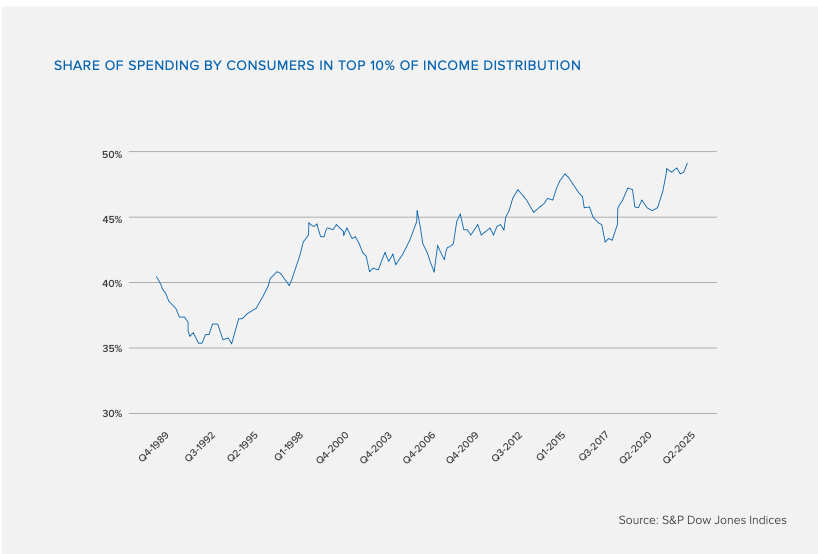
Meanwhile, lower-income households are contending with unemployment above 4%, wages still trailing inflation and a general sense that the economy is moving in an uncomfortable direction. Through all of this, however, these shoppers are still buying. They’re just more focused on finding the best deal first. In fact, half of all Cyber Week orders in 2025 arrived with a discount code, which was a 2.2% increase over 2024, according to Signifyd data.
That split is the lens you should be looking through in 2026. For high-income buyers, price isn’t the main motivator. They’re less likely to wait for a coupon or choose the cheapest option. Instead, they want certainty that they’re buying the right product and that your brand will deliver exactly what it promised. Value-conscious buyers, on the other hand, are doing the math before they hit checkout. These buyers tend to prioritize online retailers who offer the best possible deals, whether that’s free 5-to-7 day shipping or 15% off their first order.
Since their priorities are different, you can’t expect the same playbook to work for both tiers — and trying to split the difference usually shows up as lower profit per order or weaker conversion rates.
Trend #2: Optimizing for agentic commerce (and agentic commerce fraud) is critical
The Global State of Commerce 2026 report found that conversions from AI referrals in Signifyd’s Global Commerce Network increased by 1,247% year-over-year (YoY) in October 2025, signaling how much agentic AI already influenced online shopping behavior in its first truly buzz-worthy year.
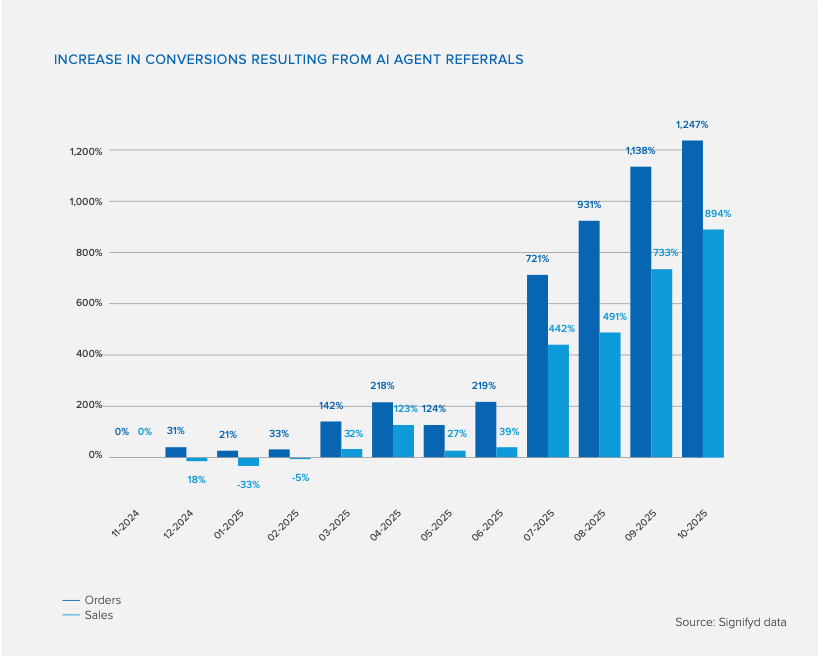
That matters because it’s not just a “traffic source” story. It’s a merchandising and discoverability story. Humans get pulled in by things like imagery, well-written copy and emotional cues. Agents don’t.
Agents want clean inputs like structured product attributes, consistent titles, clear availability, accurate pricing, shipping promises they can summarize and return policy terms they can interpret quickly. If your catalog data is messy, your product pages are inconsistent or key details are missing, you’re harder for an agent to confidently recommend even if your products are great. So, product-data hygiene is a must to better optimize for agent-led ecommerce shopping.
“Customers will increasingly delegate intent, not actions. They will say what they want and an AI agent will execute. That means your next ‘customer’ might not be a person at all. It could be an algorithm shopping on behalf of one.”
Nicholas Colisto, CIO at Avery Dennison.
That script flip also changes the trust problem. When more shopping journeys are initiated or shaped by this technology, the “who” behind an order gets fuzzier. With agentic commerce, you’re not evaluating a customer like you would in a more traditional ecommerce setting. You’re evaluating intent — and sometimes the actor isn’t sentient. The merchants who win here won’t blanket-block bots. Instead, they’ll build the muscle to separate helpful automation from harmful automation and stop mistaking efficient agent-led shopping as abuse.
Trend #3: Autonomous checkout is coming
Delegating discovery to agentic commerce agents is one thing. Letting them complete the checkout by themselves, however, is another. But that’s the new checkout frontier big players are betting on, and platforms are quickly assembling the infrastructure for agents to complete purchases without human intervention.
“The question is, is the consumer comfortable with it today, as it stands? I don’t think so. At the end of the day it is going to come down to trust with agentic. And trust is going to be built on the level of competency of the solution. ”
Carl Boutet, founder at StudioRx
Visa has enabled AI-initiated transactions through its Intelligent Commerce platform. PayPal and Microsoft are working together to roll out Copilot Checkout. And just last month Google announced the launch of their new Universal Commerce Protocol (UCP), which is set to power checkout directly in Google’s AI Mode and Gemini App. As you can imagine, other platforms are moving in the same direction, too.
For merchants, the preparation is less about being ready for autonomous checkout today and more about making sure your fraud infrastructure can handle it when human shoppers fully trust it. Legitimate agent-led orders often arrive with thinner on-site context than human-placed ones. Merchants who can make confident decisions with fewer of those signals will capture that revenue without opening the door to agentic commerce fraud.
Trend #4: Innovation is alleviating the returns challenge
Last year, the retail returns challenge hit $850 billion, per the National Retail Federation (NRF). About $260 billion of those total returns were from online purchases and 9% of all returns are fraudulent, according to a calculation based on NRF and EMARKETER figures.
Those numbers are alarming, and the problem is only getting more complicated. Shoppers expect easy returns and instant refunds. But the easier you make returns, the more you have to assume someone will try to game them — and the line between a legitimate complaint and a manufactured one keeps getting harder to spot.
Fraudsters and abusers are increasingly using generative AI to make their fake return reasons look real through cleaner fake receipts, doctored photos and more convincing item “significantly not as described” claims. Because of this, brands now have to get more precise about who gets instant outcomes and who gets routed for deeper review.
“The winners will be the merchants that can combine automation with intent-level intelligence — understanding not just what is happening, but really understanding why it’s happening. ”
Xavi Sheikrojan, director, risk intelligence at Signifyd
The answer to this challenge is smarter systems. It’s only recently that solutions have emerged aimed at actually preventing returns and responding intelligently to the different risk profiles each return request represents. And that’s where the opportunity is. For example, Signifyd’s Intelligent Returns suite, which includes Instant Refunds and Return Insights, gives merchants the ability to automatically calibrate how much friction a return request gets based on the risk it carries:
- Loyal, low-risk customers get an instant refund
- Moderate-risk requests get reviewed
- Clear fraud gets declined
That’s what innovation looks like in returns: better signals, better segmentation and better outcomes than a one-size-fits-all policy.
Trend #5: Account integrity is more important than ever
Fraud in ecommerce has always followed the money. In 2026, it’s also following the gaps in your customer account base.
ATO fraud (where criminals compromise existing customer accounts to exploit stored gift cards, payment credentials, loyalty points and store credit) grew 45% year over year in apparel, 31% in grocery and 31% in electronics in 2025, per the 2026 Global State of Commerce report. Why? One reason was very clear in the grocery sector: Signifyd found that 29% of online grocery accounts haven’t been touched in over a year. And those dormant accounts are exactly what fraud rings go looking for.
To get ahead, you need to shift from checkout-only fraud controls to full-lifecycle account defense. That means watching the entire account journey: new-device logins, unusual location or velocity, repeated failed attempts, changes to email/phone/shipping address, new payment methods added and sudden gift card balance checks or redemptions. When you can catch those signals upstream, you can stop ATOs before they turn into chargebacks down the road.
Get the full story behind these ecommerce trends
These trends all point to the same 2026 reality: Shoppers are still spending, but they’re doing it in a more segmented, value-aware market — and more of the journey is being shaped by automation.
Photo by Getty Images
Want to learn more? Signifyd’s Global State of Commerce 2026 Report digs in deeper. Read the full report to see how your vertical stacks up and where the next opportunities are likely to show up.
FAQs
How is online shopper behavior changing in 2026?
Shopper behavior is getting more polarized and more efficient. Higher-income buyers still spend, but they buy based on confidence signals like delivery certainty, quality and low-friction checkout. Value-led buyers keep shopping too, but they do the math first and time purchases around discounts and lowest-price moments.
At the same time, more sessions start deeper in the funnel because, due to AI agents, research and comparison are increasingly happening before the shopper lands on your website. That shows up as straighter paths to purchase, fewer category hops and faster time-to-cart, which raises the bar on clean product data and makes trust decisions harder when sessions come with less browsing context.
What are the biggest ecommerce trends in 2026?
The biggest trends are: a bifurcating customer base, agentic AI influencing conversions and discoverability, infrastructure for autonomous checkout, smarter returns decisioning to reduce abuse and a sharper focus on account integrity as ATO rises in certain verticals.
How are returns and refunds changing this year?
Merchants are moving away from one-size-fits-all returns. More are adopting risk-calibrated outcomes that keep returns fast for trusted customers and route higher-risk requests for review, so refunds don’t become an abuse loophole.
