





Get the Report

What happens when an online sale you’ve already recorded gets reversed weeks later? In accounting terms, that’s a chargeback: A forced reversal of a completed sale, initiated by the customer’s bank rather than the merchant.
For ecommerce businesses, the disputed transaction and any associated dispute fees should be tracked separately. Why? They behave differently on the books and can resolve on different timelines. Depending on your business’ accounting policy and the status of the dispute, you may record the transaction as a revenue reversal or track it in a disputed receivable or clearing account while the case is unresolved.
That sounds simple enough on paper. But the original sale, disputed funds, chargeback fee (if any) and final resolution can all hit the books at different times — sometimes even in different accounting periods.
TL;DR
- An open chargeback isn’t necessarily a final loss. If you contest the dispute, you may recover the funds, so your accounting treatment should reflect whether the case is still open or resolved.
- The disputed amount is only part of the cost. Chargebacks can also bring internal labor, third-party expenses and losses tied to merchandise or services already delivered.
- You can plan for chargeback exposure and potentially shift some of it. Historical dispute patterns can help finance teams estimate future losses, while a fraud protection provider that offers a financial guarantee can take on liability for eligible chargebacks.
How does a chargeback work in accounting?
Say a shopper buys a $250 winter jacket from your ecommerce store on November 28. You collect the payment, ship the jacket and record the sale.
Three weeks later, the customer disputes the transaction through their issuing bank, saying they didn’t recognize the charge. Your payment processor deducts the $250 from an upcoming payout. Depending on its fee structure, the processor may also charge a dispute fee.
You haven’t necessarily lost the $250 yet. If you fight the chargeback, the disputed funds may remain unresolved until the issuer decides whether the payment should stand.
From the original sale through the final resolution, each event creates a different accounting question: How was the original revenue recorded? How should you treat the $250 while the dispute is open? Where should any chargeback dispute fee go? What changes if you win and get the funds back? And how should you record the loss if the chargeback becomes permanent?
Example flow of how the chargeback process works:
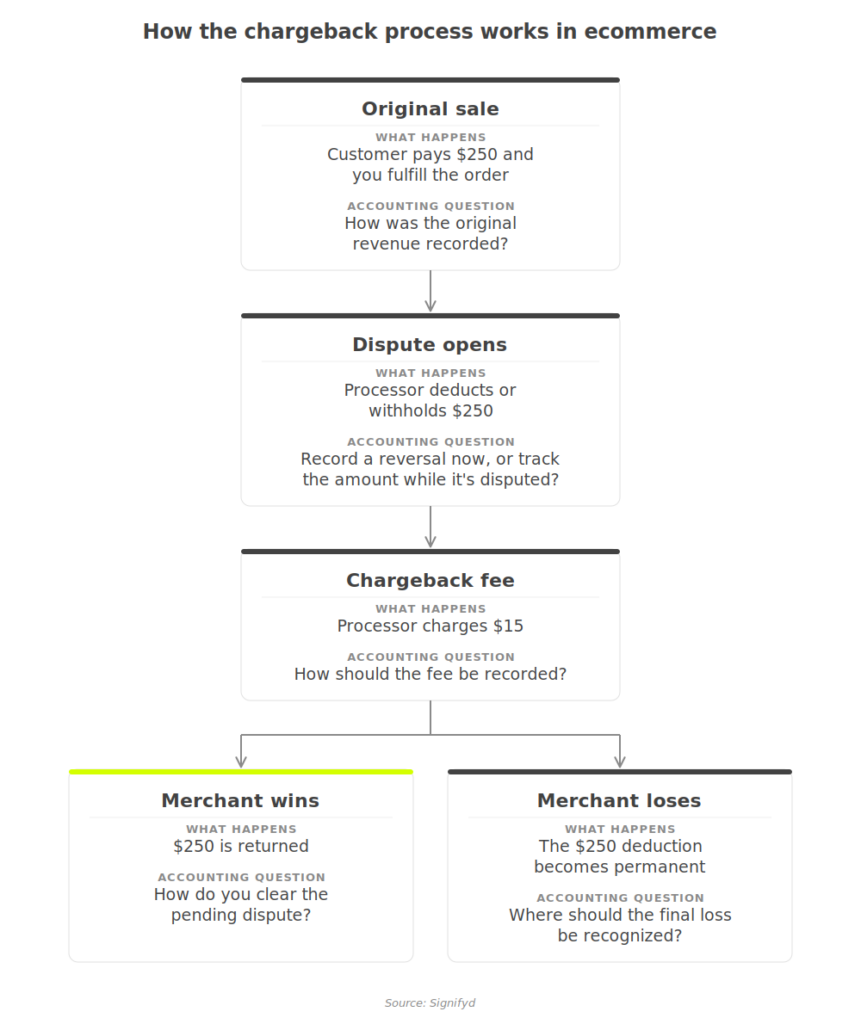
Those events may fall in different accounting periods. If you challenge a dispute, issuer review alone commonly takes 60 to 75 days, and the full dispute lifecycle can take two to three months.
So a November holiday sale could become a dispute in December and still be unresolved in February. Because of this, chargeback accounting should distinguish sales, open disputes, final losses, recoveries and related fees rather than treating every processor adjustment the same way.
How do you record a chargeback journal entry?
How you book an ecommerce chargeback depends largely on whether you recognize the financial effect when the processor withdraws the funds or separately track the disputed amount while the case remains unresolved. Your accounting policies and the facts surrounding the transaction also matter.
Using our $250 disputed sale, let’s assume for illustration that the processor charges a $15 dispute fee. The entries below show two ways to record the disputed payment and fee. The jacket’s inventory cost was already recorded as cost of goods sold when you shipped it, so it doesn’t appear in these entries.
Option 1: Record the financial impact when the chargeback hits
One approach is to recognize the financial impact as soon as the processor withdraws the money. The entry could look like this:
| Account | Debit | Credit |
| Sales returns contra-revenue | $250 | — |
| Chargeback fee expense | $15 | — |
| Cash or processor clearing | — | $265 |
In plain terms, $265 has left your available funds: $250 for the disputed transaction and $15 for the processor fee.
A contra-revenue account reduces reported revenue rather than treating the adjustment as a normal operating expense.
The tradeoff is that the chargeback may still be unresolved. If you later win and the $250 is returned, you’ll need to record that recovery and reverse the earlier treatment as appropriate.
Option 2: Track the amount separately while the dispute is open
Another approach is to wait to treat the disputed transaction as a final loss until the issuer decides the case.
If your accounting policy supports treating the $250 as recoverable while the dispute is pending, the entry could look like this:
| Account | Debit | Credit |
| Disputed funds receivable or clearing account (asset account) | $250 | — |
| Dispute fee expense | $15 | — |
| Cash or processor clearing | — | $265 |
The same $265 has left your available funds, but you treat the $250 differently.
Instead of recording it as a revenue reduction or loss, you move it into a temporary disputed-funds account. In this scenario, your books are saying: “We don’t have this $250 in cash right now, but we may get it back.” And the $15 fee is still tracked separately as an expense.
This approach can make it easier to distinguish money tied up in active disputes from money your ecommerce business has permanently lost. Depending on the quantity and materiality of your chargebacks, this method may not be allowed. So, check your external reporting obligations.
What happens if you contest and win the chargeback?
If you successfully contest the chargeback and the processor returns the $250, how you record the recovery depends on how you initially treated the dispute.
If you used Option 2 and tracked the amount in a disputed receivable or clearing account, an illustrative entry could look like this:
| Account | Debit | Credit |
| Cash or processor clearing | $250 | — |
| Disputed funds receivable or clearing account | — | $250 |
The $250 moves from money you were waiting to recover back into actual cash or processor funds, and the original sale remains intact.
Any dispute fee or dispute counter fee is separate. If your processor charges either, they may return some or all of it if you win depending on your market and agreement.
What happens if you fight the chargeback and lose?
If the issuing bank rules against you, the disputed amount becomes a permanent loss. You would then recognize the final financial impact according to your accounting policy.
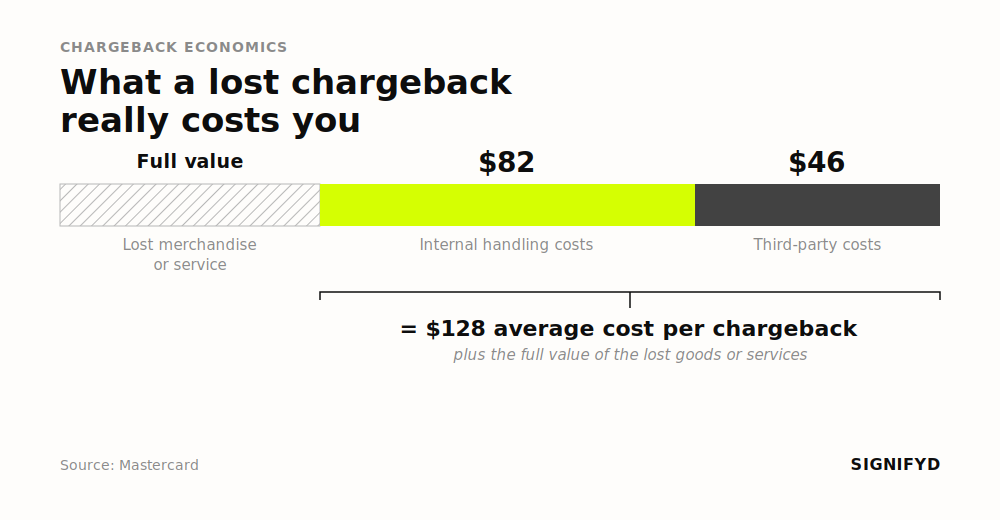
For ecommerce merchants, the accounting entry doesn’t capture the true total monetary loss. According to Mastercard, merchants spend an average of $82 in internal costs and $46 in third-party expenses (like a chargeback counter fee) per chargeback. If you’ve shipped the order and don’t recover the product, you’ve also borne the cost of those goods.
However, if the order is covered by a liability shift arrangement, losing the dispute doesn’t mean you bear the covered chargeback loss. Reimbursement of the sale amount, rather than only the product’s cost, helps protect the margin on the order.
How do chargebacks show up on the balance sheet?
A chargeback doesn’t usually appear as a standalone line item on the balance sheet. Depending on the status of the dispute and your accounting treatment, it can impact:
- Cash
- Clearing
- Or receivable accounts and funds held in processor reserves
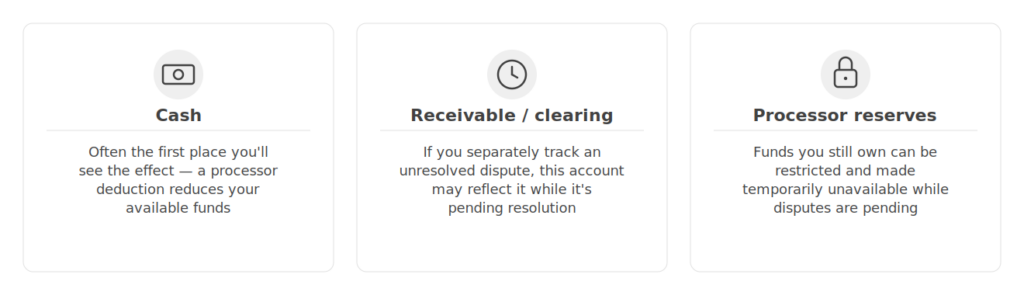
Cash is usually where the impact shows up first. When a processor deducts a disputed transaction from an upcoming settlement, your available funds decline. If you separately track an unresolved dispute, a receivable or clearing account may also be affected.
Processor-held reserves are a separate balance sheet consideration. If your processor withholds part of a settlement, those funds remain owed to your business until the processor releases them. Your finance team may track the withheld amount as a receivable from the processor, depending on the arrangement.
Chargebacks may also affect how you report revenue. If they’re frequent and material, your reporting obligations may require your finance team to estimate the effect on sales you’ve already recorded.
Should ecommerce merchants reserve for chargebacks in advance?
If chargebacks are material to your financial statements, your finance team generally needs to estimate the exposure related to sales you’ve already recorded. Yes, even if customers haven’t filed every dispute yet. Historical chargeback data can help support that estimate.
Your team might consider factors like:
- Historical chargeback rates
- Average disputed amounts
- Recovery or win rates
- Seasonality
- The time between the original transaction and final dispute resolution
How your business reflects the estimate in its financial statements depends on the nature of the chargebacks and the applicable accounting standards. That could mean an adjustment to revenue, a liability or another accounting treatment.
What’s the difference between a processor chargeback reserve and an accounting reserve?
A processor chargeback reserve is money a PSP or acquiring bank temporarily holds to make sure funds are available to cover future disputes. It can affect the merchant’s liquidity without necessarily representing a permanent loss. The accounting for this has no impact on revenue or expense. Instead, since the customer has paid you, the receivable simply shifts from the customer to a receivable from your processor.
That’s different from an amount your finance team estimates or recognizes on your own books for expected losses. ASC 606 includes requirements for refund liabilities when a business expects to return consideration to customers, but that doesn’t mean every open card dispute should automatically be treated as a refund liability.
During high-volume periods, expected dispute exposure can rise at the same time more cash is tied up in open chargebacks or processor reserves.
Why does chargeback accounting get harder during the holidays?
Q4 magnifies the timing problem.
Deloitte forecasts U.S. ecommerce sales will reach $316.1 billion to $318.9 billion between November 2026 and January 2027, up 7.5% to 8.4% from the same period a year earlier.
At the same time, merchants are dealing with growing first-party misuse. From January through April 2026, Signifyd’s Commerce Network recorded a 9% increase in first-party fraud and abuse compared with the same period in 2025.
Merchant-reported data shows the pressure is more widespread, too. MRC’s 2026 Global Ecommerce Payments and Fraud Report found 64% of merchants reported increasing rates of friendly fraud, with one-quarter saying those rates increased by at least 25% over the last year.
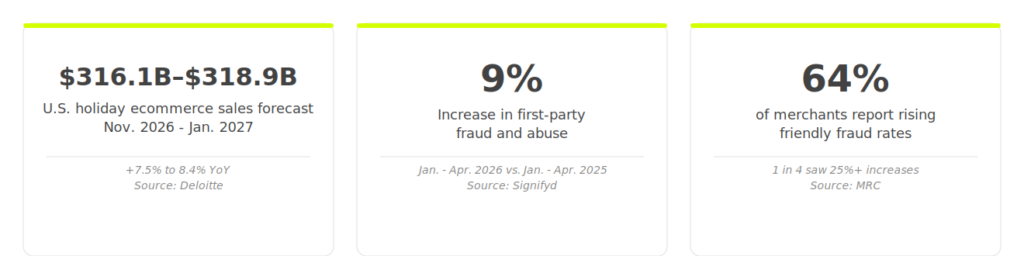
Put those trends together and you’re heading into the holidays with more transactions to process and growing exposure to disputes that can originate from your own customers. The accounting impact doesn’t necessarily show up when the sale does, either — remember, a contested chargeback can take a few months to reach a final decision.
So, an order you record during Cyber Week could be disputed after Christmas and remain unresolved into Q1 of the next year. That creates a gap between when you record the sale and when you know whether you’ll keep the payment.
A strong December can therefore be followed by January and February settlements that reflect holiday disputes. Because those disputes cross year-end, your finance team may need to estimate their effect on reported revenue while also preparing for financial audits, sales tax returns and income tax returns.
What does a $0 chargeback balance sheet look like this holiday season?
Technically, there’s no standard balance-sheet line called “chargebacks.”
A $0 chargeback balance sheet shouldn’t mean a set of books with absolutely no chargeback activity. A more meaningful goal is $0 in eligible chargeback losses ultimately borne by the merchant.
Imagine you’re an ecommerce retailer that generates $5 million in holiday sales. Over the following weeks and months, $50,000 of those transactions result in chargebacks. Here’s how the economics differ depending on whether you bear those losses or liability for eligible chargebacks is shifted to a provider like Signifyd.
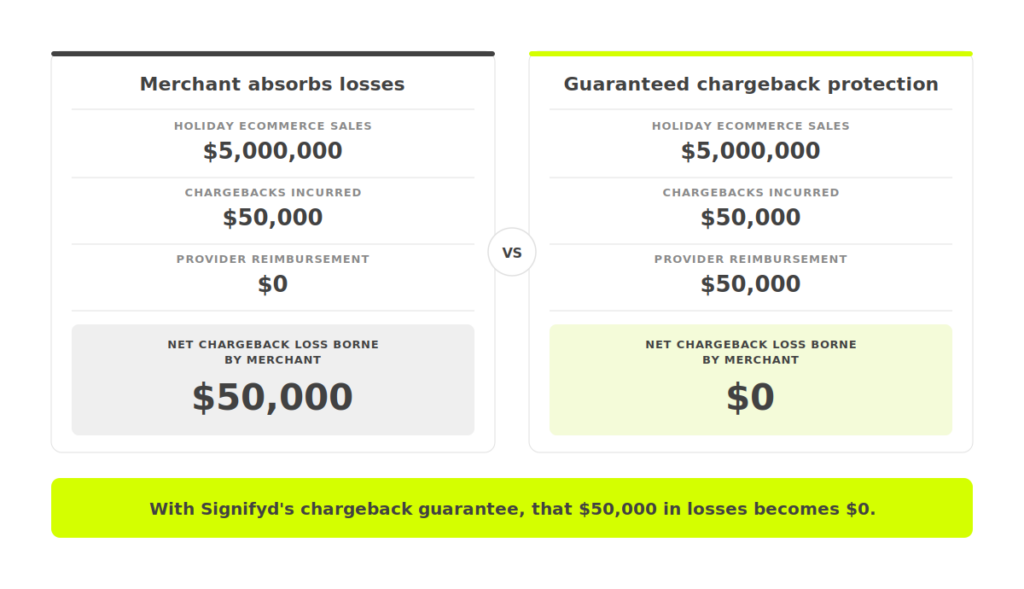
That $0 doesn’t mean customers filed zero disputes or that finance had nothing to reconcile. Customers can still initiate chargebacks, processors can still withdraw funds and your team may still need to account for reimbursements.
Under a liability shift arrangement with Signifyd, for example, when an eligible, covered chargeback occurs, your team records a receivable for the chargeback amount and covered fees, with no reduction to revenue or chargeback expense. On top of that, Signifyd reimburses the covered sale amount rather than only the cost of the shipped product, helping protect the margin on that order.
See what $0 in chargeback losses could mean for your ecommerce business
Chargebacks can still happen. But with the right protection and recovery strategy in place, you can reduce how much of that loss lands on your books —and give your accounting team fewer unrecovered losses to track.
Signifyd’s Complete Chargeback Protection provides guaranteed protection against eligible fraud and non-fraud chargebacks on approved orders, helping shift that liability away from your business. And Signifyd’s Chargeback Recovery helps you challenge abusive disputes and recover revenue that might otherwise be lost.
See what reducing chargeback losses could look like for your business.
FAQs
Are chargebacks an expense or a reduction in revenue?
When a merchant ultimately bears a chargeback loss, the disputed sale amount reduces revenue, either directly or through a contra-revenue account. The chargeback fee is recorded separately as an operating expense.
For an eligible chargeback covered by a liability shift partner like Signifyd, the merchant instead records a receivable for the covered chargeback amount and fees. Those covered amounts do not reduce revenue or create an expense.
What is a chargeback reserve?
A processor chargeback reserve is money a payment processor or acquiring bank temporarily holds to cover future disputes.
How is a chargeback different from a refund?
A refund is usually a known decision, while a chargeback can catch a merchant by surprise.
With a refund, you’ve agreed to return the customer’s money. A chargeback is initiated by the customer through their issuing bank, and you may believe the original transaction was legitimate and choose to submit evidence to recover the disputed funds.
There’s another ecommerce reconciliation problem to watch for: A customer can dispute a transaction after you’ve already issued a refund. Without transaction-level reconciliation, the same purchase can potentially generate both refund activity and chargeback activity that your finance team needs to identify and resolve.
